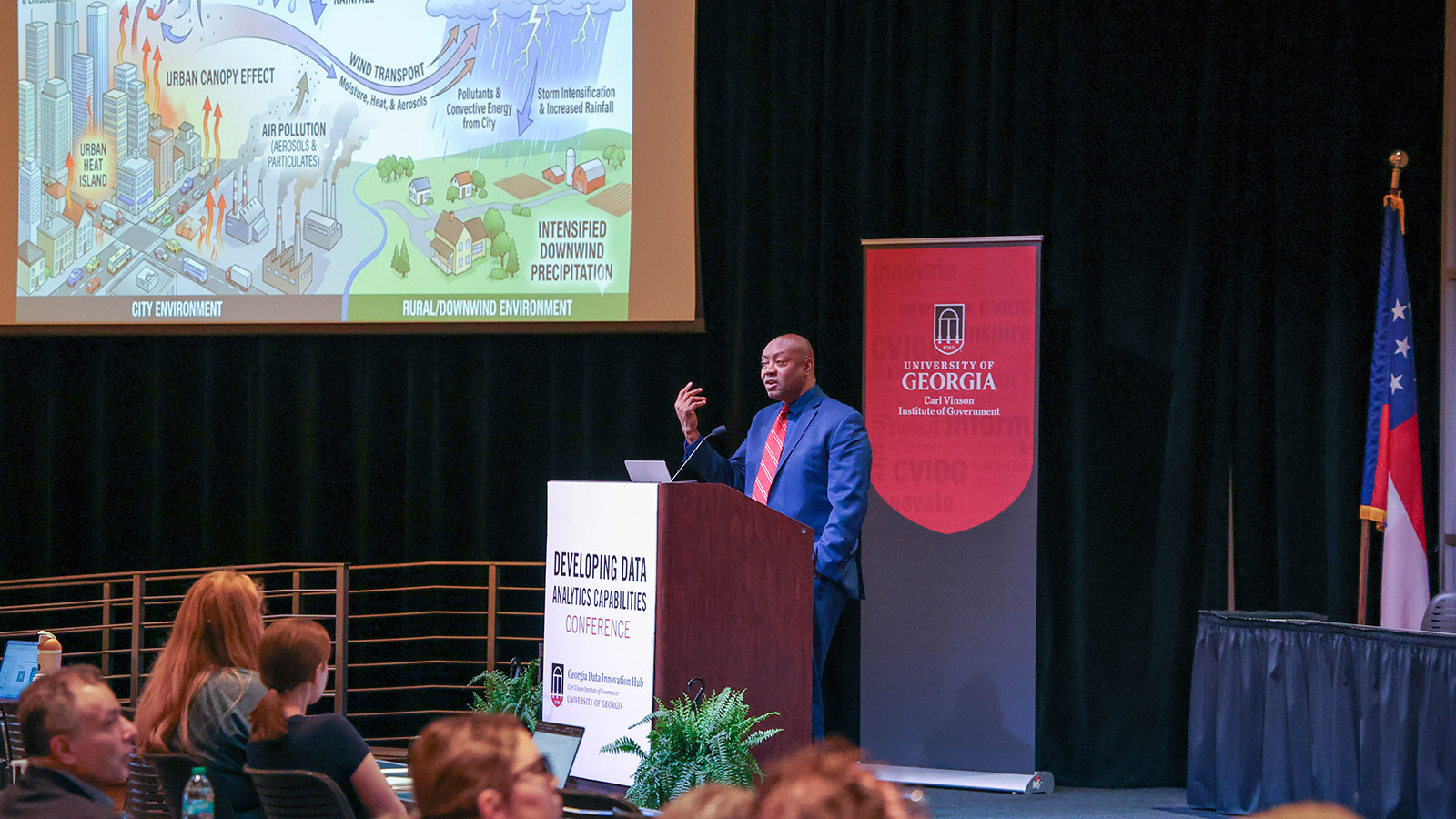
UGA Regents Professor J. Marshall Shepherd joins The Weather Channel experts to discuss weather data visualization at data conference
Data analysis and visualization skills are a hot commodity across job roles and industries. One of the most intriguing applications—weather forecasting—is also essential to public safety.
Such was the takeaway at a recent event hosted by the Georgia Data Innovation Hub at UGA. The hub, an initiative of the University of Georgia Carl Vinson Institute of Government, offers governments technical assistance and training in data analytics, data visualization and predictive analytics. Its signature event, the annual Developing Data Analytics Capabilities Conference, brings together data practitioners to network and learn from industry experts.
At the 2026 conference this spring, presenters included UGA Regents Professor J. Marshall Shepherd and The Weather Channel’s Matt Sitkowski and Mike Chesterfield.
The three explained how effective weather forecasting relies on data storytelling. Shepherd set the stage with a weather data overview, and Sitkowski and Chesterfield spoke about advanced data visualization technology used to translate data into forecasts.
Shepherd serves as Franklin College of Arts and Sciences associate dean, UGA Department of Geography’s Atmospheric Sciences Program director, and host of the “Weather Geeks” podcast. He noted that while data is plentiful and easily accessible, it takes a skilled professional to analyze, interpret and package that data into meaningful and actionable insights.
“What you’re seeing is useful information presented in a way that you can use to make decisions, but it’s actually data converted to information from essentially a set of ones and zeros,” he said. “We’re in an era of rapid dissemination, availability, equalization and democratization of data, particularly in the weather space. It creates challenges for us in terms of communicating credible and authoritative data.”
Forecasts start with an amount of data that seems unfathomable.
 |
| Attendees at the 2026 Developing Data Analytics Capabilities Conference listen as
The Weather Channel’s Matt Sitkowski talks about weather data collection methods.
(Photo by Cameron Pearce, UGA) |
From weather balloons and satellite imagery to ocean buoys and aircraft data, the National Oceanic and Atmospheric Administration (NOAA) and National Weather Service (NWS) collect more than 210 million weather observations in the United States each day, said Sitkowski. Those millions of data points are vetted and analyzed, informing the complex models meteorologists use to develop weather forecasts.
However, all that data can only go so far on its own.
“We create a compelling narrative with the data to tell a story to our viewers so they can plan and make decisions to protect their families and their communities,” said Sitkowski, The Weather Channel’s science editor-in-chief.
Recent advances in data visualization tools enable The Weather Channel team to create hyper-realistic videos that demonstrate risks of hazardous weather. The videos place real people in recognizable places using immersive graphics and animation. These videos can show viewers storm surge impacts on coastal streets or what to expect when a strong tornado rips through a neighborhood. Such visuals might show the height of predicted stormwater against a well-known playground or park feature, for example.
Viewers are more likely to take protective actions after watching these videos compared to other warning methods, such as storm surge maps, said Chesterfield, The Weather Channel’s vice president for weather presentation and data visualization.
 |
| The Weather Channel’s Mike Chesterfield shows an example of a video created to demonstrate
storm surge risks during a keynote presentation at the 2026 Developing Data Analytics
Capabilities Conference. (Photo by Cameron Pearce, UGA) |
“Good visualization is not only able to convey a particular message to the public, but also identifies particular risks,” Chesterfield said. “Visuals have been found to enhance our understanding and shape our perception of risk.”
That insight is not unique to weather. Data visualization is an essential skill and tool across many fields.
The Georgia Data Innovation Hub offers trainings in data storytelling and data visualization software, such as PowerBI, for governments. In addition to the annual conference, data practitioners can learn new skills through the hub’s webinars, in-person trainings and a certificate program.
“Everyone has access to more data than ever before,” said David Tanner, Institute of Government associate director. “Our goal with the Georgia Data Innovation Hub is to empower governments across the state to effectively analyze and interpret their data to better serve Georgians.”
For more information, visit the Georgia Data Innovation Hub on the Institute of Government’s website.